
Timeless Truths About Advertising, Part I
How Advertising Behaves
After more than two decades working in advertising, I've accumulated a few observations about the enduring patterns that govern the business. Perhaps that's to be expected, particularly since much of my career has focused on measuring advertising's effects. This is the first of a three-part series collecting some of those observations.
Part I examines how advertising behaves: the natural mechanics of media planning, audience reach, frequency, and campaign delivery. Part II turns to how advertising influences consumers, exploring concepts such as recency, adstock, wear-out, brand building, and why advertising changes buying behavior over time. Part III tackles perhaps the most contentious subject of all: how we know whether advertising actually worked. We'll explore incrementality, attribution, targeting, experiments, identity, bots, and why separating cause from coincidence is far more difficult than many marketers assume.
Reasonable people disagree about some of these observations, but they've shaped how I think about advertising and measurement throughout my career. I hope you find them useful.
1. Reach beats frequency
Reach and frequency are advertising's two fundamental currencies. Reach is the number (or percentage) of people exposed to a campaign. Frequency is how often they are exposed. Given a fixed budget, advertisers should generally favor building reach over adding frequency. Brands grow by increasing the number of buyers, not by repeatedly reaching the same buyers. The objective is effective reach, not maximum frequency. Ironically, because of gaps in ad tracking and the fact that frequency tends to accumulate naturally among heavy media users, you're probably buying more frequency than you realize anyway.
2. Frequency is heavily concentrated
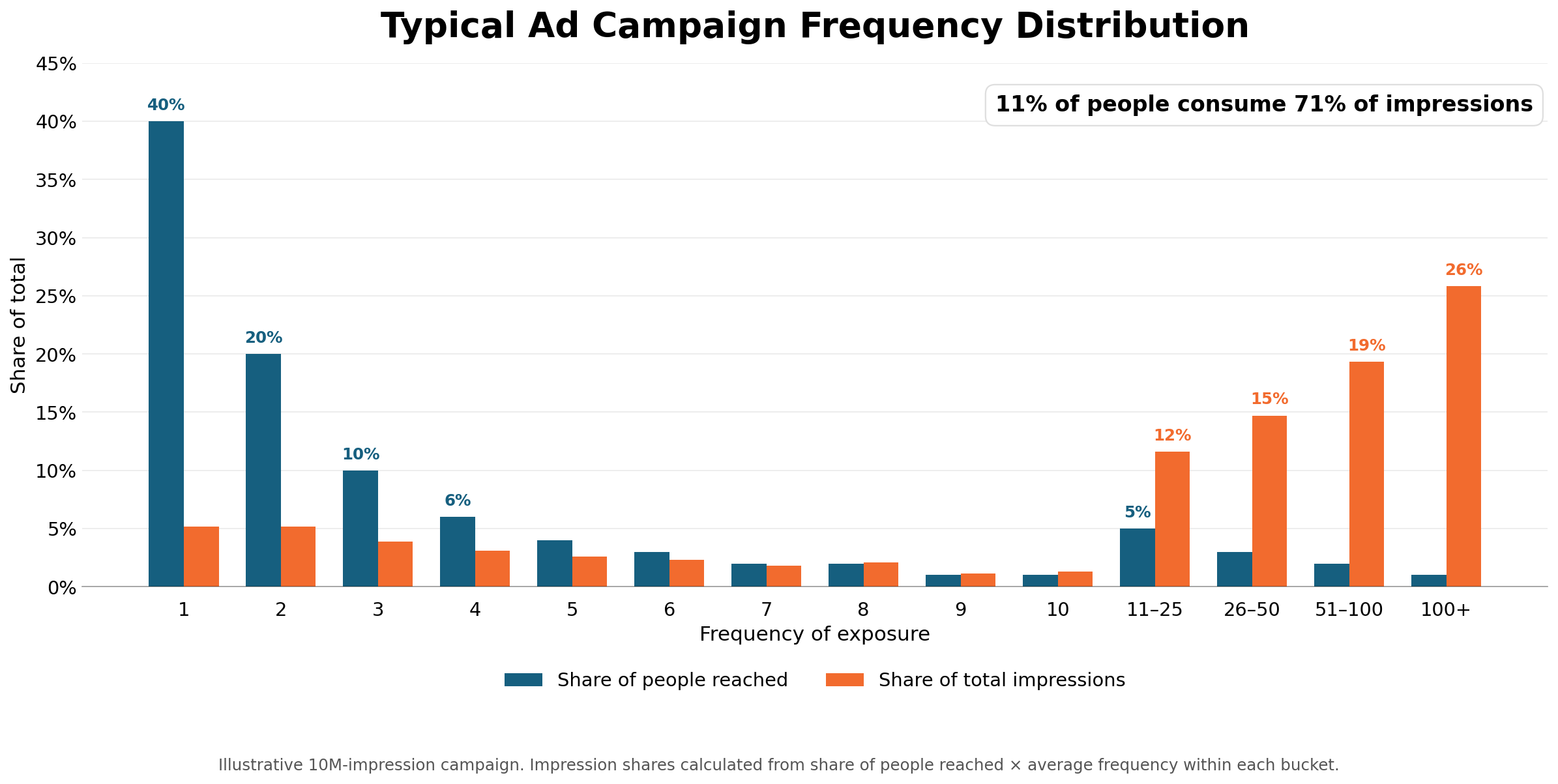
Advertising frequency is not normally distributed. Most people receive only one or two impressions, while a relatively small group accumulates dozens or even hundreds. The result is a heavily right-skewed distribution in which the average frequency can be highly misleading. In the illustrative campaign below, typical of what I've seen studying thousands of campaigns over several years, the mean frequency is 7.7, but the median consumer sees only two ads. Meanwhile, just 11% of the audience consumes 71% of all impressions, a highly inefficient use of ad dollars. Advertisers should examine frequency distributions, not merely averages, and use broader media plans and sensible frequency caps to reduce waste.
3. Broad media plans build more reach
People consume different media. Every additional publisher, platform, or channel reaches some people who weren't reached elsewhere in the media plan. Because audiences overlap only partially, broader media plans usually generate more incremental reach than concentrating impressions in fewer outlets. They also moderate the natural tendency for frequency to accumulate among heavy media users. When the objective is growth, breadth generally outperforms concentration.
4. Most ad metrics are time-bounded
Reach, frequency, click-through rates, conversion rates, sales lift, and virtually every other advertising metric are meaningful only over a specified period of time. A frequency of five means something very different over a day than over a month, just as a 2% conversion rate means something different over a week than over a year. One of the worst reporting habits is to report metrics over the entire life of a campaign. A three-month campaign and a twelve-month campaign are simply not comparable unless their metrics are normalized to a common time period. The same principle applies when comparing against industry benchmarks or historical campaigns. Time is part of the definition of the metric. Ignore it, and meaningful comparisons become impossible.
5. Television is bought in time. Digital is bought in impressions.
The distinction goes to the heart of why television and digital advertising behave differently. This is what's meant by calling television "linear": commercials are inserted into a fixed sequence of programming, and every ad slot exists only once. Like an unsold airline seat or an empty hotel room, if that moment passes unsold, the inventory disappears forever. Digital advertising, by contrast, is bought impression by impression. Every page view, app session, or video stream creates another opportunity to sell an ad, making inventory virtually unlimited. Television inventory is constrained by time; digital inventory is constrained primarily by audience activity. That difference explains why digital delivery naturally concentrates impressions among heavy media users while linear television tends to distribute them more broadly over time.
6. Advertising constancy beats periodic campaigns
The first five observations have been about how advertising is delivered. This one begins to bridge into how advertising influences consumers.
There is a reason the Advertising Research Foundation named its lifetime achievement award after Erwin Ephron. One of the most influential thinkers in the history of media planning, he left behind a body of work that continues to shape the profession decades later. His slim volume, Media Planning, has served as a bible for generations of media planners and researchers. I had the privilege of having lunch with Erwin a few times in the early 2000s. He was as charming and generous as he was influential.
Among Ephron's most enduring contributions was the concept of recency planning, rooted in a substantial body of research showing that advertising has its greatest influence in the few days before a consumer makes a purchase, when they are actively in the market for a category purchase. Because advertisers can't predict when an individual's cereal box will run empty or washing machine will fail, he argued that maintaining a steady advertising presence throughout the year is usually more effective than concentrating budgets into occasional bursts around promotions, holidays, or product launches. For most brands, the same annual budget simply works harder when spread consistently over time than when delivered in intermittent waves.
We'll return to why recency works in Part II, where we'll examine adstock, advertising decay, wear-out, and how advertising changes buying behavior over time.
Next: Part II, How Advertising Influences Consumers.