
The only thing AI can't do in advertising is measure true ROI
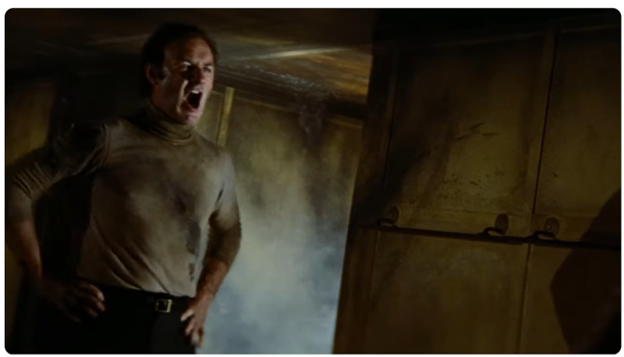
“You’re going the wrong way, dammit!” (The Poseidon Adventure, 1972)
AI is the future advertisers deserve.
Someone recently asked for my take on the WSJ opinion piece AI Is About to Empty Madison Avenue, whether I thought it was overhype or not. In short, no, I don’t think it’s hype.
Industry watcher Don Marti observed in a recent piece that advertisers could defend themselves from losing the advertising game to Big Tech. (They could do it for themselves by using higher-quality measurement techniques. Better yet, the IAB, ANA and other bodies could refer to the blueprint for fixing the whole ROI mess, which Marti cited, that I wrote in AdExchanger more than a year ago.) But in a piece he wrote a couple of weeks earlier, he makes a more convincing argument that they probably won’t, because they’re sleepwalking into oblivion.
I think the AI hype is real. The saying goes that we regularly overestimate the impact of new technologies in the short term and underestimate their impact in the long term. But in this case, the future is already here. AI is moving at the pace of a runaway train.
Not all profound technical advances fundamentally alter professions. Photography, for example. While film manufacturers and processors were rocked, and camera makers lost significant market share to high-quality cell phone cameras, photographers themselves have remained strongly employed. It’s a case of Woody Allen’s Law: 80 percent of success is showing up. Someone still needs to attend the wedding, the bird-watching expedition, the celebrity outing to hold the camera and click.
But that’s not so much the case with most advertising jobs. There’s nothing particularly physical to do. AI is already showing up with the skills needed to do most of the jobs in advertising: understanding the brief, planning the media, developing the creative, executing the buy, delivering and counting the impressions. That whole value chain sits squarely in AI’s sweet spot. And it can crank it all out in minutes, take endless feedback, and make revisions with the most insidious can-do attitude imaginable, without so much as an eye roll.
Tilly Norwood, Sora 2, Advertising Context Protocol: the writing is scribbling on the wall so fast you’d think AI was writing it itself.
This Ad Age story about Butler/Till claiming to have executed the “first” fully AI ad campaign, soup to nuts, is likely to read like a quaint footnote in a year’s time. Talk about a dubious claim to fame. More like an epitaph.
Google, Meta, and Amazon already command the lion’s share of ad spending, and they’re highly automated and increasingly AI-driven. Zuck has said he envisions cutting out all the middlemen and automating all components of the ad stack between the brief and the conversion, which sounded boastful a few months ago but now seems blindingly obvious.
I had an aha moment a couple of weeks ago while attending a Sports Media summit hosted by Operative. Carter Satterfield, a Google Cloud sales executive, shared this story. He’s a big sports lover, spending hours each week coaching his son’s hockey team. On the train ride to the conference, he paused his scrolling to watch a video ad featuring a father and son bonding over the kid’s hockey team. When the kid scores a goal at the end of the ad, Carter realizes he’s wearing the same jersey number Carter himself wore all through high school.
“I can’t be sure it was an AI-generated ad, but it certainly could have been — all of the details are there in my social feed to put it together,” he said. “I don’t normally cry on Amtrak. But I did this morning.”
When’s the last time you could even remember an internet ad you’ve seen? And here was one that brought a seasoned ad professional to tears. It felt like a real tipping point. I’ve contended for years that one-to-one marketing was the biggest fallacy of digital advertising, since the ads weren’t really designed for or targeted to one person. But now, they literally can be.
None of this is to say the future of advertising is going to be better than it was. Or more effective. I’m old enough to know how to spell “bologna” because my baloney has a first name. Advertising impact used to endure for a lifetime.
All that said, there is one thing AI cannot do accurately — the most important thing: measure ROI accurately. But perversely, advertisers just don’t seem to care.
ROI for most advertisers is falling in inverse proportion to Big Tech valuations going up. Advertisers are steadily paying more for less ROI, and Google, Meta, and Amazon are laughing all the way to the blockchain.
If there is one thing marketers have even heard about causation — which, of course, is the ultimate point of advertising, causing consumers to buy your product who wouldn’t have otherwise — it is that correlation is not causation. But AI, you see, is nothing but correlation. Very fast and very sophisticated statistical inference. The fact remains that to truly know what is having an effect, you need to conduct a randomized experiment: subjects assigned at random to a test or control group, presented with an intervention where they are either treated or not with the stimulus of interest (the ad), and measured against the outcome of interest (incremental sales).
A click isn’t that. Attribution modeling isn’t that. Synthetic controls, matched-market tests, double-debiased machine learning, stratified propensity score modeling, and all manner of other “baffle them with bullshit” mechanisms of statistical inference are not that. Those are all forms of correlation. True experiments — randomized controlled trials — are really the only way to know, really know, what kind of effect a marketing strategy is having.
But we don’t need AI to tell us that most marketers will settle for lesser evidence. Self-reporting AI “optimization” engines with Newspeak names like Performance Max and Advantage Plus gobble up ever larger shares of ad spend, while marketers watch their cost-per-acquisition rise.
I used to think about this stuff and feel like Reverend Scott, Gene Hackman’s character in The Poseidon Adventure, screaming at the people convinced they needed to go to the ship’s bow, now underwater, to get out instead of following him to the engine room, now above water, because the ship was upside down.
How does it even make basic business sense that the seller would devise systems that optimize the deal to the buyer’s best interest, not the seller’s own?
“You’re going the wrong way, dammit!”
But over the years, I heard from enough people to realize that whether the advertising works isn’t really the priority in the advertising business. Even though, of course, it should be. What they mean is that it isn’t their priority, in their job function, or in their self-interest. Their priority, and that of their colleagues across the advertiser, the media company, the agency, the whole stack, is simple: spend the money. Spend it as fast as you can, lest, God forbid, there’s budget left over and you get less next time. Whether it really works or not isn’t their concern, so long as they have a nice chart to show their boss afterward. Test and learn be damned.
Shoot first and ask questions later. Kill ’em all, let God sort ’em out.
All I can do is preach. Most people probably think I’m just an old man shouting at clouds. But here and there someone hears me who recognizes the truth in what I’m saying, and I can help a few souls at a time, like Reverend Scott.
What do I think AI portends for advertising? Mothers, don’t let your babies grow up to be cowboys. Or, as Frank Zappa put it: don’t you know you could make more money as a butcher?